
XGS-PON – the Industry Standard
by Fredy Künzler
Reading time: 8 minutes
XGS-PON – the Industry Standard
About 20 years ago, the first tentative experiments with FTTH (Fiber to the Home) were undertaken. Since then, not only has the geographic spread of fiber optics expanded rapidly, if not exponentially, but the associated technology has also evolved considerably. Whereas bandwidths in the megabit range were common at first, today people speak only of gigabit or more. Our Fiber7-25-Gigabit offering, affordable for private customers, has been the benchmark in Switzerland since 2021, if not worldwide.
Ethernet (AON)
On OSI Layer 2, that is, at the level of the electronics that ensure connectivity on the last mile between the end customer’s fiber optic outlet (OTO) and the first aggregation point, the fiber PoP, there are two fundamentally different technologies: Ethernet (AON) and PON.
Ethernet originally comes from the field of local networks. It always establishes a connection between two devices and is usually plugged in with an 8-wire copper cable.

Image: Ethernet cable, photo by Claudio Schwarz on Unsplash
Such Ethernet cables can be found in almost every household that has a computer and an internet connection. When several devices need to be connected to one another, a switch is used or, as is usually the case, the switch function of the broadband router.
However, Ethernet also works over longer distances than the physical limit of the copper cable, which is 100 meters. Fiber optics are of course used for this. Different bandwidths are also possible; in the carrier and data center environment, they reach up to 400 gigabits per second today. Even higher speeds are in the standardization phase. For the sake of completeness, it should be mentioned that Wi-Fi is also fundamentally based on Ethernet.
PON
In contrast, a different technology than Ethernet has become established, particularly for FTTH: PON. PON stands for Passive Optical Network. The optical fiber signal is distributed passively, that is, without electronics, to multiple connections. In contrast to PON, Ethernet is sometimes referred to as AON (Active Optical Network). Our colleagues at iWay have explained the differences between AON and PON in their blog (German).
PON has also evolved over the years. The original PON with bandwidths of under one gigabit per second is no longer relevant today. Currently, GPON is widespread in many countries and enables bandwidths of 2.5/1.25 gigabits per second (download/upload). XG-PON offers 10/2.5 gigabits.
However, the next evolutionary step has already been standardized: 25G-PON and 50G-PON are already available in select places.
XGS-PON
XGS-PON has become the established standard: X stands for 10, G for gigabit, and S for symmetric. Download and upload are thus equally fast, each at 10 gigabits per second. Roughly 80% of the nominal speed is actually achievable. All major providers in Switzerland use this technology. SALT was the first provider to introduce XGS-PON, in 2018. The offerings from Yallo, Sunrise, Swisscom, and also all current fiber subscriptions based on the market leader’s BBCS resale platform use XGS-PON.
The great advantage of PON over Ethernet (AON) is the massively lower investment cost per connection. At Layer 2, that is, the electronics, it is up to 80% less. Or put differently: to connect an XGS-PON customer, the provider only needs to invest about a quarter to a fifth of the capital. The disadvantage: PON divides the bandwidth among several customers. This is done with a passive optical splitter. Splitters between 2 and 256 ports are commercially available; it is also possible to cascade splitters. For example, the market leader often uses 4-way splitters, which are in turn plugged into 16-way splitters. The most widespread are 32-way splitters. The network topology thus looks like a tree with 32 branches or, in the case of the market leader, like a tree with four branches, each of which in turn has 16 branches.
The Economic Advantage of XGS-PON
It should therefore hardly surprise anyone that most providers rely on inexpensive XGS-PON, since the customer experience is “similar” to an Ethernet connection – at least that is the opinion of the finance chiefs of almost all providers. The nominal XGS-PON speed of 10 gigabits is thus divided among 32 or more customers.
Of course, we at Init7 are also confronted with these economic laws. When all market participants market “10 gigabit” and mean inexpensive XGS-PON by that, we are at a commercial disadvantage with our Fiber7, which offers unshared 10 gigabit over Ethernet. It is like comparing a Škoda with a Porsche. Both have four wheels and a steering wheel. However, the driving experience, or in this case the customer experience, is easier to convey with cars than with internet connections, and so it bothers nobody that the Porsche is more expensive than the Škoda.
10 Gigabit Is Not 10 Gigabit – Or Is It?
Our problem, then, is that our premium product Fiber7, realized with expensive Ethernet electronics from Cisco, is compared in price with the standard XGS-PON offerings from Yallo, SALT, and Wingo. Explaining this was often frustrating and is mostly not relevant for price-sensitive customers anyway. The XGS-PON quasi-standard costs around CHF 40 per month, and even if the line is shared, XGS-PON is often “good enough.” Init7 therefore had a disadvantage in the low price segment compared to competitors.
We tried to make up for this disadvantage in 2023 with our Easy7. Its completely different positioning from Fiber7 appeals to a customer segment looking for a “worry-free internet subscription.” Fully automatic router configuration, good quality, 1 gigabit bandwidth, and unshared. After all, Easy7, just like Fiber7, is an Ethernet product.
Easy7 is successful, but still more expensive than the competitors’ XGS-PON offerings, if only by a few francs per month. But because innovation is deeply rooted in Init7’s DNA, we did not simply sit back. Instead, between summer 2025 and today, we have been tinkering in our lab to adapt the price advantage of XGS-PON within the Init7 infrastructure.
The New Ciena Micro OLT
A new OLT optic (Optical Line Terminal) from Ciena, which is plugged into the existing Cisco switches at the PoP, allows us to granularly supplement the existing Fiber7 PoPs with XGS-PON technology.
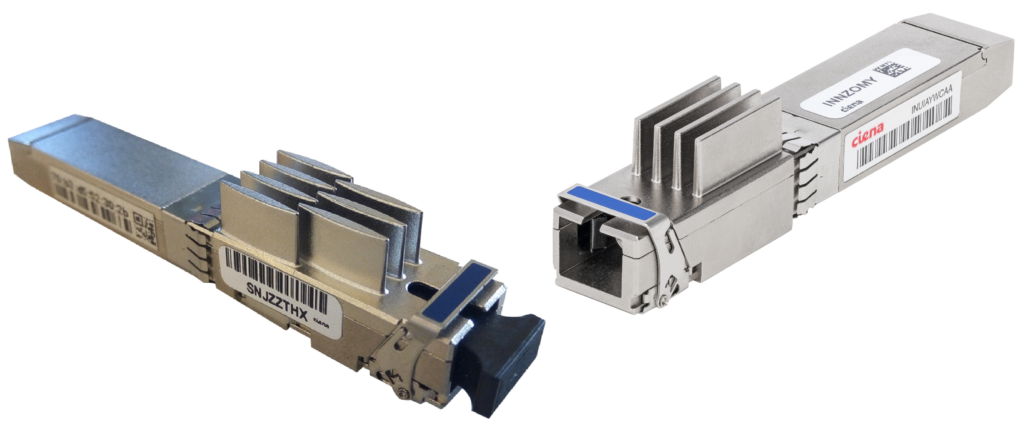
Image: Ciena OLT optic, source: Ciena
In doing so, we in particular had to take into account the prescribed 24- and 48-fiber cabling (in technical jargon: AV4 connection variant 4) of the exchanges. The goal was to use our XGS-PON splitters without having to modify the existing provisioning software for the FTTH connections. But we mastered this challenge as well. Together with our suppliers DN Solutions, we found a way to build the splitters directly into the fiber distribution modules from the manufacturer R&M.
Now the lab tests and field trials are complete, and we are ready for the soft launch of our new product Basic7. It combines all the positive achievements of Easy7 – “Unpack. Connect. Surf.” – with the more cost-effective XGS-PON technology. The router is also identical for Easy7 and Basic7: the FRITZ!Box 5530. With this, we have arrived at the quasi-industry standard, naturally in the same price class as competitors SALT, Wingo, and Yallo.
Basic7 Is Better – Despite XGS-PON
The same price class, but better. Of course, we aim for Basic7 to stand out qualitatively from the rest as well. This succeeds for two reasons:
1. At our company, every PON tree has its own 10-gigabit port on the switch in which the Ciena Micro OLT is plugged. A PON tree usually serves 24 customers, at some locations 32. Never more. The switch itself has 1 or 2 x 100 Gbit/s of uplink capacity. We therefore do not need to install new, additionally power-consuming hardware, but can simply swap an optic in the existing switch and thereby introduce XGS-PON technology. It looks something like this.

Image: Init7
2. Instead of the granularly deployable Micro OLT from Ciena, competitors use large OLT chassis, some of which serve well over 100 PON trees with 32 customers each. That is, more than 3,000 customers on one device, which has only 10 to a maximum of 40 Gbit/s of uplink capacity.
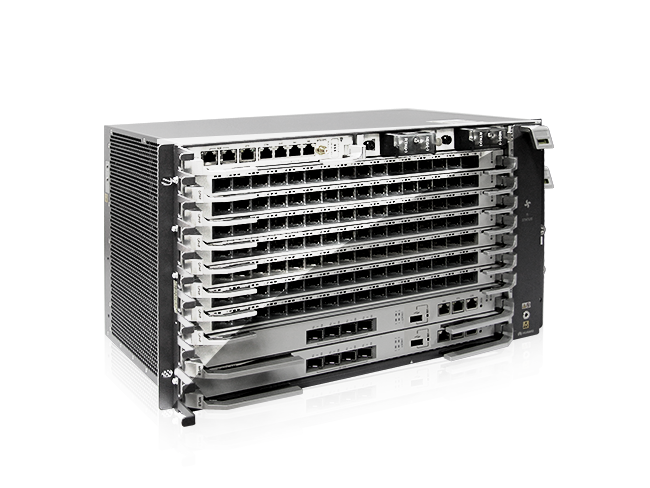
Image: EA5800-X7, source: HUAWEI
The nominal 10-gigabit XGS-PON connections sold by competitors are thus massively more oversubscribed than our new Basic7. This so-called overbooking occurs with all providers, so the question is: how much overbooking is still acceptable? Less is more – our earlier blog article goes into detail on the topic.
Basic7 is therefore our new XGS-PON-based internet product for price-sensitive customers. “All you need,” but better than at the others. Fully automatically provisioned, ideally suited for surfing and streaming. Even on Sunday evening in prime time, when everyone else is online as well. The better economics of Basic7 lie in the cheaper XGS-PON technology and in the use of Carrier Grade NAT (CGNAT), which treats the scarce IPv4 resources with care. We have not skimped on anything else. Init7 customers can thus choose between two products: the affordable Basic7, based on the industry standard XGS-PON, and the higher-quality Fiber7 with 10 or 25 gigabit, which is realized over Ethernet and offers more technical possibilities.
Our XGS-PON Rollout
We will deliberately start Basic7 with a “soft launch” and not with a big bang. This is mainly because the existing 433 Fiber7 PoPs (as of October 5, 2026) must first be supplemented with the new XGS-PON infrastructure. Of course, this does not happen overnight, even though our infrastructure colleagues at Suter & Bähler are doing a fantastic job and are actively supporting us with the rollout. We therefore expect that by mid-2027, Basic7 will be available as a new product at all locations where Fiber7 is available. Easy7 will gradually fade into “end of sale” as availability of Basic7 grows.
But Wasn’t There Something About the Fiber Dispute?
Correct. The Fiber Dispute, an extensive antitrust proceeding against Swisscom, which ultimately ended in a ban on the PON topology. How does that fit in with XGS-PON and Init7’s Basic7?
That is definitely a legitimate question. The decisive point is the distinction between PON at Layer 1 and Layer 2. At Layer 1, that is, the type of network topology, PON or P2MP (Point to Multipoint) was in fact banned by the Competition Commission and the subsequent court instances. The matter essentially concerned the positioning of the splitters. As long as these are installed in the exchange or PoP, there is no antitrust problem. Positioning the splitters in neighborhoods or individual buildings, on the other hand, would have caused “market foreclosure” (quote from the ruling in the Fiber Dispute). We have already described the details of the two network topologies earlier in our blog.
If a provider therefore opts for XGS-PON as a technology based on PON or P2MP, the PON topology is effectively mapped onto the P2P (Point to Point) topology. P2MP can be implemented on P2P, but the reverse is not possible.
P2P Enables Technology Competition
P2P as a network topology is therefore necessary for technology competition between providers to function unhindered – so ruled the Federal Administrative Court. Without P2P, Fiber7 on an Ethernet topology would not be possible, and neither would Basic7 on XGS-PON, because as competitors of Swisscom we would not be able to install our own splitters in all neighborhoods and housing developments ourselves. The splitters must therefore be installed in the exchanges or PoPs, and so every provider has the opportunity to choose the technology that is optimal for its purposes.
XGS-PON has thus become the quasi-industry standard. From the perspective of Layer 2, that is, the electronics, it does not matter where the splitters are installed. From an antitrust perspective, however, it does. Unhindered competition only works if the PON tree has a very short trunk and long branches. That is why the Competition Commission banned a long trunk and short branches, because that would have allowed Swisscom to monopolize the fiber network. That this did not happen is thanks to our victory in the Fiber Dispute.