

by Fredy Künzler
Reading time: 9 Minuten
FTTH fiber optic construction from the perspective of property owners
Residential and commercial buildings in Switzerland have been connected to FTTH fiber optics for over 15 years now, and after initial skepticism among some property owners, the general consensus now is that FTTH is not a nice-to-have for tenants, but a necessity. A property with FTTH is simply worth more than one without.
But not so long ago, tenants were dependent on the goodwill of their landlords. It was only with the new Telecommunications Act (TCA) that the situation changed — we reported on the new legal situation in our blog in 2021.
Article 35 FMG obliges property owners:
Articles 35a(1) and 35b of the new FMG are particularly relevant for private and institutional property owners.
Art. 35a(1) requires the toleration of various telecommunications service providers, also known as internet providers.
1 Building owners and must tolerate, insofar as it is reasonable, additional connections to dwellings or business premises other than the connection of their choice, if a telecommunications service provider so requests and pays the costs thereof.
Art. 35b hingegen regelt das Mitbenutzungsrecht von Verkabelungen innerhalb des Gebäudes.
1 Every telecommunications service provider shall have a right of access to the building entry point and of joint use of the installations within the building intended for telecommunications transmission provided this is technically justifiable and there is no other good cause for refusal.
2 Building owners and telecommunications service providers must allow the joint use of the installations within the building in a transparent and non-discriminatory manner.
3 Building owners and shall make the required information on the installations within the building available to the providers on request.
4 Providers who have financed an installation must be compensated appropriately.
5 If requested to do so, ComCom shall rule on disputes between telecommunications service providers relating to access to the building entry point or the conditions for joint use. Article 11b applies by analogy.
Property owners therefore have a duty to grant access to all telecommunications providers and may not discriminate. The aim of the legislation is to ensure competition in the telecommunications market so that no one can establish a monopoly in a market area (village, neighborhood, etc.). End customers should be guaranteed freedom of choice regardless of their landlords.
From a legal perspective, a monopoly or market dominance always refers to a specific market. This is referred to as market definition. The relevant market can be very small and refer to a single building, for example.
In many places, buildings are only connected by a so-called network operator (FTTH fiber optic provider), which can be identified by the label (OTO ID) on the fiber optic box. Read more about this in the blog article «How to read your OTO-ID».
The nonsensical superstructure
In some places in Switzerland, there is a situation known as «Überbau». This term refers to a situation where competing network operators provide dual access to buildings and apartments. Two OTOs with four fibers each in one apartment, even though hardly anyone subscribes to more than one service. There is broad consensus in the industry that «Überbau» makes no economic sense, wastes resources, and is rarely financially attractive. However, due to the vague wording of Article 35b of the FMG, legal proceedings have been underway for some time regarding its exact interpretation. Paragraph 2 regulates the groups affected by the article of the law:
2 Building owners and telecommunications service providers must allow the joint use […] manner.
The legislator is therefore placing responsibility on property owners and internet providers.
In some market areas in Switzerland, namely Ascona, Baden, Chiasso, Massagno, Morges, Pully, Siggenthal, and Wettingen, the private Swiss4Net Group is active and is connecting thousands of households with FTTH. Swisscom, for its part, does not want to surrender these rather urban areas to the competition without a fight and is therefore also connecting these locations. This inevitably leads to duplication, which is clearly visible on our FTTH map using the example of Wettingen (red: Swisscom and Swisscom/Swiss4Net available; yellow: only Swiss4Net available).
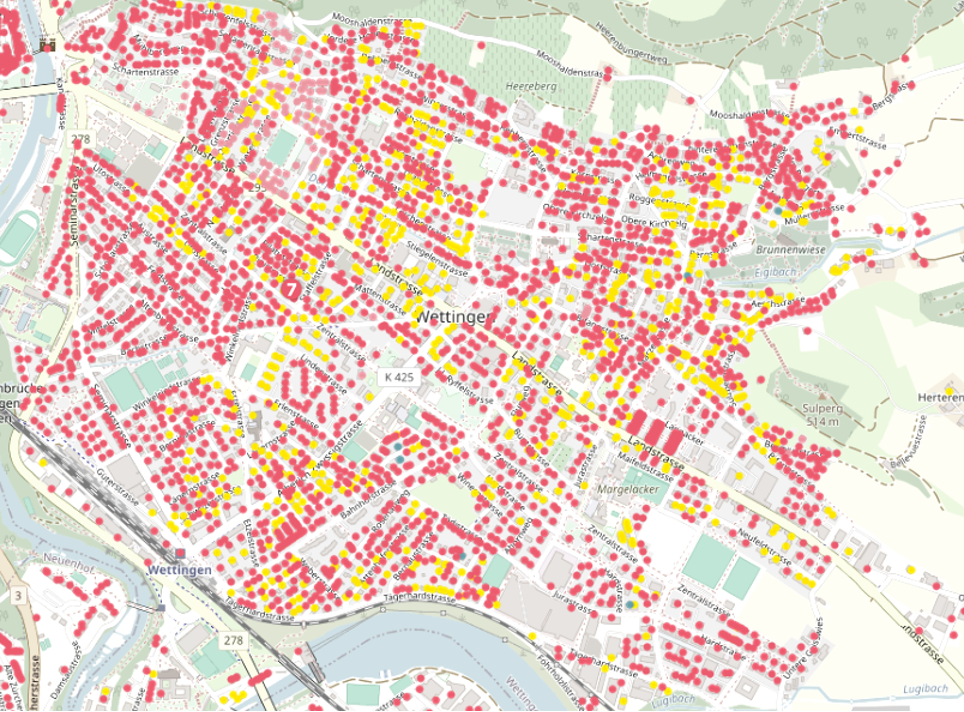
Source: Init7
From the perspective of alternative internet providers such as Init7, this situation is unfortunate. In order to cover the entire market area, two POPs are required at the location instead of just one, so that all potential customers in the area can be served. This means higher investments and greater operating costs.
The situation is also nonsensical from the perspective of tenants or companies: often, two OTOs are simply installed, as in Siggenthal – one by Swiss4Net and one by Swisscom:
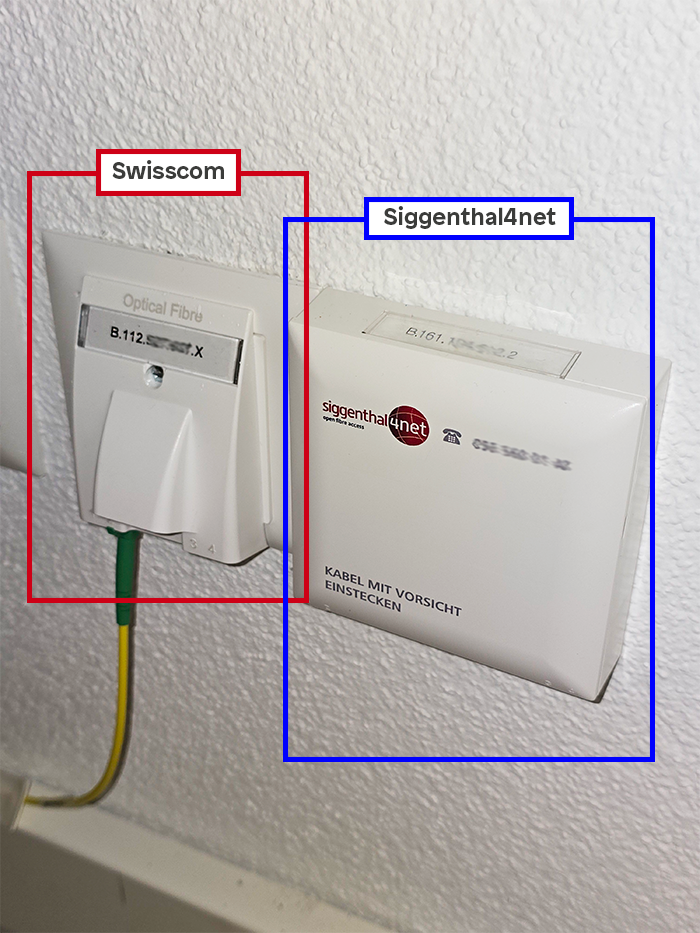
Source: Init7
The legislator’s idea was to avoid such a situation with Article 35b FMG. The first provider must allow the second (or third…) competitor to use the existing cabling in the building, if necessary for a fee. However, Swiss4Net and Swisscom were unable to agree on either the price or the terms and conditions.
Swisscom initiates proceedings against Swiss4Net
Swisscom has therefore submitted a so-called access request to the regulator, ComCom, requesting that Swiss4Net be required by order to allow shared use of the OTOs it has built. Swiss4Net, however, believes that the legislator deliberately left a loophole in the Telecommunications Act (known as qualified silence), as Swiss4Net is neither a telecommunications service provider nor a property owner, but rather a builder of fiber optic infrastructure, which is not mentioned in the list in Article 35b(2) FMG. The proceedings have been ongoing since the end of 2023, with lawyers arguing about the meaning and purpose of Article 35b ever since. In its ruling of October 13, 2025, the regulator, ComCom, and also the court of second instance, the Federal Administrative Court (BVGER), sided with Swisscom (the respondent). The Swiss4Net Group (the complainant) has appealed the ruling to the Federal Supreme Court; therefore, it may still take some time before there is clarity.
Assuming Swisscom were to prevail in the Federal Supreme Court, the horse race would start all over again. Swiss4Net would then be obliged to submit an offer to Swisscom within six months for the shared use of cabling and OTOs. It doesn’t take much imagination to realize that this offer would probably not be within Swisscom’s desired price range. A renewed appeal through the courts is therefore almost inevitable.
Time is therefore on Swiss4Net’s side, because as long as Swisscom does not have access to the existing OTOs, making a duplicate rollout difficult to justify or explain and resulting in additional costs. This dispute is certainly not in the spirit of the legislature, which wanted to avoid expensive duplication.
One subject of dispute, but different jurisdictions
Another unfortunate aspect of Article 35b FMG is that the legislator has not assigned all disputes exclusively to ComCom. The regulator is only responsible for disputes between FDA, for example, if Sunrise wants to connect the OTOs built by Swisscom in a building with its own fiber optic cable, but Swisscom wants to prevent this. Fortunately, such a case is hypothetical, as the industry has agreed on the procedure.
The situation is different for recalcitrant property owners, because ComCom is not responsible. In new buildings, the OTOs and cabling are financed by the building owner (so-called new building clause, see below). If the builder decides that Sunrise cannot enter the building because they do not like the company, thereby limiting the choice of provider for their tenants, then this is a matter for the civil court. To our knowledge, there have been no such cases to date – unfortunately, one might say. A precedent-setting ruling would be helpful when negotiating with institutional property owners as an FDA.
The profitability of installing your own fiber optic network
As an alternative to the FDA, installing your own connections in buildings with many apartments is actually quite lucrative. In many cities and suburban communities, high-rise buildings and large developments with hundreds of apartments have already been built or are under construction, as the Tages-Anzeiger (paywall) recently reported. An FDA can quickly calculate the market share required for its own cable or mini-POP to be profitable. This is because its own connection eliminates the need to pay for the supply line per customer – with ALO, this currently costs CHF 24 per month.
Assuming that an FDA has a market share of 7% in a 500-unit development, this corresponds to 35 customers. 35 * CHF 24 per month ≃ CHF 10,000 per year. Depending on the length and circumstances (assumption: 500 meters to the nearest pop), laying your own cable costs around CHF 25,000 one-off and around CHF 100 per month (pipe rental KK-FMG). After 44 months (3 years and 8 months) of operation, the break-even point for the own cable has been reached. Instead, the FDA can of course also install a mini-POP in the technical room of the development and rent a supply line from another FDA, which changes the return calculation for the better, depending on the circumstances.
This proposal will only be profitable if the FDA can connect to existing OTOs. In new buildings, these are financed by the building owner, as it is assumed that they must provide telecommunications cabling to their tenants. In the past, this meant connecting to the telephone network and cable TV, but today, FTTH fiber optics are naturally installed instead. This practice is in line with the so-called «new building clause». According to Article 35b FMG, an FDA has the right to share the use of the cabling and OTOs and does not have to pay the owner a fee for their use, as this is already covered by the owner’s tenants.
FTTH tips for building owners
We recently received the following inquiry from a property management company:
How does fiber optic connectivity actually work in new buildings (apartment buildings)? Sometimes UPC gets in touch, sometimes Swisscom/Axians, and in the end, as a construction company or owner, you sign a contract with some company so that you have fiber optics in the building. Do these companies divide the projects among themselves, or is it more a case of «first come, first served»? What is the specific difference between signing a contract with UPC or Swisscom? Of course, you are not neutral, but if you were to build a new building, how would you arrange the fiber optic connection? Would you sign contracts with several companies? You should sign a contract with at least one company, as this is owed to the tenants.
Article 35b FMG answers these questions quite well. As already mentioned, the building owner finances the cabling between the technical room and the apartments (OTOs) on the basis of the new construction clause. For this purpose, one or more BEPs (Building Entry Points) are installed in the technical room and a 4-fiber cable is laid to the respective OTO in the apartment. To avoid complications later on (access to the tenants’ apartments), it is advisable to splice all 4 fibers of the OTO and fit them with connectors.

Source: Init7
Each OTO is then available with all four fibers in the BEP on a cassette. According to Article 35b FMG, an FDA now has the right to claim one fiber for itself. Swisscom normally gets fiber 2, Sunrise fiber 4. Fiber 1 is often connected by the local energy supplier, fiber 3 is available to other interested parties. The numbering of the OTOs (B.xxx.xxx.xxx.y) is usually done by the first FDA that connects the building. For Swisscom, these are the B.110/B.111/B.112 OTOs, for Sunrise B.278, and for Init7 B.377 – we have explained the OTO ID scheme in our blog post «How to read your OTO-ID».
It is therefore advisable for the building owner to conclude more than one contract in order to offer tenants maximum choice. It goes without saying that a contract must not contain an exclusivity clause; such a clause would in any case be void, as Article 35b FMG applies. Conversely, this means that the building owner is even obliged to conclude non-discriminatory contracts with all FDAs.
Don’t wait until the last minute to think about fiber optics
It makes sense for the construction project if the client invites interested FDAs to the development in good time. This requires very little: the address and/or plot, planned development pipes, intended use units (apartments, commercial premises), and the expected date of first occupancy. At the appropriate stage, meaning before the excavation pit is filled in again, an FDA may wish to install its own supply pipe. The larger the development, the more attractive it becomes to multiple FDAs.
Of course, developers have the option of seeking independent advice, as development agreements are usually quite complicated. One company that specializes in advising institutional property developers is Strukturwerk in Winterthur. Either way, it makes sense to shop around and always consider recommendations from the perspective of the person making them. An FDA has a commercial interest in producing its internet subscriptions as cost-effectively as possible. Tenants, on the other hand, want the widest possible choice of high-quality broadband connections at a reasonable price. This is also the intention of the legislator, which is why it places obligations on FDAs and property owners.
FTTH on demand – for homeowners
The question remains for people with single-family homes who have been waiting for fiber optics for years but unfortunately live in a location that has been deliberately overlooked by Swisscom or other network operators. Or, for the «white spots» on the FTTH-Map. Sometimes – not always – you can speed up the expansion with a few thousand francs. Swisscom’s program is called «FTTH on Demand» and costs around CHF 6,500 for a single-family home or CHF 10,000 for an apartment building with four units (guide prices, subject to change, depending on local conditions). «FTTH on Demand» does not require you to commit to a subscription with Swisscom once the connection has been set up. As an «FTTH on Demand» customer, you are free to pick your provider of choice. «FTTH on Demand» connections are also built in P2P (point-to-point) network topology, which is mandatory everywhere thanks to the fiber optic dispute that has been won.
Do you have questions about FTTH development in residential complexes? Then please write to support@init7.net and open a ticket. Please note that processing may take a few days.